
Investors are caught between two possible outcomes as the new trading week begins: a swift deal that ends the war, or a major escalation that could drive oil prices and bond yields even higher. With trading volumes reduced due to the holiday period, markets remain especially sensitive to developments.
Trump Issues Strong Warning to Iran
President Donald Trump issued a blunt ultimatum on Sunday, warning that Iran would be “living in Hell” if the Strait of Hormuz is not reopened by Tuesday at 8 p.m. ET. He described the deadline as “Power Plant Day, and Bridge Day, all wrapped up in one.”
In a separate interview with Fox News the same day, Trump said he was hopeful there was a “good chance” a deal could be reached by Monday.
Conflicting Signals Shake Investor Confidence
These mixed messages have created uncertainty in global markets, forcing investors to prepare for sharply different scenarios.
At the same time, Iran has rejected Trump’s latest threats, stating that the strategic waterway will only fully reopen once Tehran receives compensation for war-related damages. Over the weekend, Iran continued its military actions across the Gulf, including strikes targeting Kuwait’s oil headquarters.
Markets React to Rising Uncertainty
“Markets are on edge, as time is running out and the outcomes are binary — truce or escalation,” said Rob Subbaraman, head of global macro research at Nomura.
He added that Trump’s tone reflects growing urgency within the White House to bring the conflict to an end, while investors continue adjusting their positions to hedge against escalation risks.
Volatility Increases Across Financial Markets
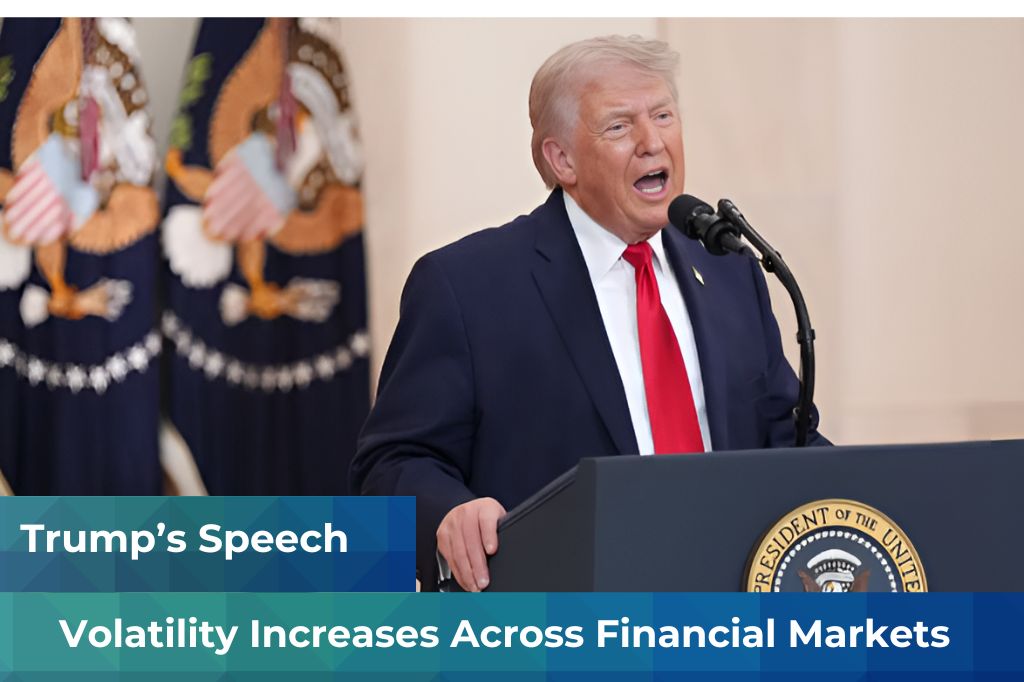
Trump has alternated between describing negotiations with Iran as productive and warning of intensified military action. He has also repeatedly extended deadlines for reopening the Strait of Hormuz.
This inconsistent messaging has contributed to increased market volatility and unstable oil trading.
The S&P 500 rose 3.4% last week, marking its strongest weekly performance since November, as investors bought into the possibility of a diplomatic resolution. Meanwhile, the Cboe Volatility Index climbed from below 20 before the war to around 24 last week.
Investors Adjust to Unpredictable Policy Moves
“Trump’s escalatory tone over the weekend is very much in line with his playbook: headline-driven, unpredictable, and designed to apply maximum pressure quickly,” said Mohit Mirpuri, an equity fund manager at SGMC Capital.
He added that markets may need to adapt to this style of policymaking for the foreseeable future.
Stagflation Risks and Energy Crisis Concerns
The ongoing monthlong war and the effective blockade of the Strait of Hormuz are raising concerns about a potential global energy crisis—possibly one of the most severe in history.
Analysts warn that even if a diplomatic breakthrough occurs, markets may not see immediate relief.
Oil Prices Surge Sharply
Brent crude prices climbed to $109.77 per barrel on Monday, roughly 50% higher since the conflict began on Feb. 28. U.S. West Texas Intermediate crude has surged 66%, reaching $111.2 as of 11 p.m. ET.
Shipping Disruptions Continue
Despite a slight increase in recent days, shipping traffic through the Strait of Hormuz remains significantly disrupted. Before the war, the route handled nearly a quarter of the world’s seaborne oil and about one-fifth of its liquefied natural gas.
Currently, traffic levels are still about 95% below prewar levels, highlighting the ongoing strain on global energy supply chains.