

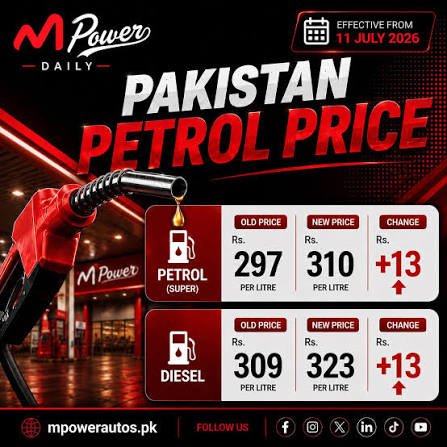
Pakistan’s petrol price rises Rs13.18 to Rs310.71/litre from July 11 as diesel jumps Rs13.80, driven by renewed Iran-US tension near Hormuz.
Introduction
Govt Raises Petrol Price by Rs13.18, Diesel by Rs13.80
Pakistan's Petroleum Division raised the petrol price by Rs13.18 a litre and high-speed diesel by Rs13.80 late Friday. The new rates — Rs310.71 for petrol, Rs323.30 for diesel — took effect at midnight, opening the July 11 fortnight higher than the last one closed.
Islamabad had cut prices just a week earlier. Now it's reversing course, and the reason sits roughly 3,000 kilometres away in the Strait of Hormuz, where tankers spent the past few days dodging renewed strikes between the United States and Iran.
What Changed at the Pump Overnight
The Petroleum Division's notification was brief. It confirmed the new petrol price and diesel rate, and named Saturday, July 11, as the effective date — standard timing for Pakistan's fortnightly fuel pricing cycle, which typically lands revisions on the 1st and 16th but has moved around repeatedly since the Iran war began in February.
Petrol matters most to two-wheelers, rickshaws and small private cars, the vehicles of Pakistan's middle and lower-middle income households. Diesel cuts wider and deeper. It runs the trucking fleet, the intercity buses, the tube wells irrigating Punjab's cotton belt, and the backup generators keeping small factories running through loadshedding. When diesel moves, freight costs move with it. Freight costs eventually show up on a grocery receipt.
A Climate Levy Buried in the Fine Print
Not all of this increase traces back to crude oil. Under conditions attached to Pakistan's ongoing IMF programme, the government doubled its climate support levy to Rs5 per litre effective July 1, trimming the regular petroleum levy to compensate. The math still lands the same way for a driver at the pump. Diesel now carries close to Rs80 per litre in petroleum levy alone, plus roughly Rs16 in customs duty and freight-equalisation charges — total taxation near Rs101 per litre. Petrol isn't far behind, at about Rs95 per litre once its Rs70 levy, Rs20 customs duty and the new Rs5 climate charge are added up.
| Component | Petrol | Diesel (HSD) |
|---|---|---|
| Petroleum levy | ~Rs 70 | ~Rs 80 |
| Climate support levy | Rs 5 | Rs 5 |
| Customs duty | Rs 20 | Rs 16 |
| Total tax, approx. | ~Rs 95 / L | ~Rs 101 / L |
Petrol and diesel aren't a footnote in Pakistan's budget, either. Together they move 700,000 to 800,000 tonnes a month, dwarfing the 10,000 tonnes of kerosene the country burns in the same stretch. They're the government's steadiest revenue line, which helps explain why relief cuts tend to arrive smaller and slower than the hikes.
Tax load per litre, after the July 1 revision
| Component | Petrol | Diesel (HSD) |
|---|---|---|
| Petroleum levy | ~Rs 70 | ~Rs 80 |
| Climate support levy | Rs 5 | Rs 5 |
| Customs duty | Rs 20 | Rs 16 |
| Total tax, approx. | ~Rs 95 / L | ~Rs 101 / L |
Six Months That Rewrote the Record Book
Context helps here, because Rs310.71 sounds almost tame against what Pakistan just lived through. Petrol traded around Rs266 in the first week of March. By April 3 it had rocketed to Rs458.41, an all-time high and the largest one-day jump in the fuel's recorded history. Diesel fared worse, spiking to Rs520.35 the same day.
Public anger was immediate. Prime Minister Shehbaz Sharif announced an emergency Rs80 cut within 24 hours, then a deeper reduction on April 11 that brought diesel down by Rs134.81 in a single move, still the largest relief cut on record. Prices kept swinging through April, May and June, drifting anywhere from roughly Rs300 to well above Rs400 as fortnight after fortnight tracked a war that refused to settle. By July 4, petrol had eased back to Rs297.53. That relief lasted exactly one week.
Price timeline, February–July 2026
| Date | Petrol Price | What Happened |
|---|---|---|
| Feb 28 | Rs 266 | US-Israel strikes on Iran begin; Hormuz shipping disrupted |
| Mar 7 | Rs 321.17 | Biggest one-day hike to date; OGRA moves to weekly reviews |
| Apr 3 | Rs 458.41 | All-time record high as accumulated subsidy is passed on |
| Apr 11 | Rs 366.58 | PM Sharif orders emergency relief; diesel cut by Rs134.81 |
| Jun 18 | — | US-Iran sign MOU to reopen the Strait of Hormuz |
| Jul 4 | Rs 297.53 | Prices near their lowest point since the war began |
| Jul 11 | Rs 310.71 | Today's hike, as fresh Hormuz strikes lift crude again |
Why a Waterway 3,000 Kilometres Away Sets the Petrol Price at Home
The mechanics are almost mechanical. OGRA prices petrol and diesel off the Arab Gulf benchmark, converts that figure at the prevailing exchange rate, then layers on taxes fixed in Islamabad. Every dollar move in Brent crude shifts the pump price by roughly Rs1.50 to Rs2 a litre. Every rupee of currency depreciation adds another 60 to 80 paisa, even when the oil price itself hasn't moved at all.
And the oil price has been moving. Brent eased below $70 a barrel on July 1, days after the US and Iran signed a memorandum of understanding to reopen Hormuz, a corridor that carries roughly a fifth of the world's seaborne oil. The calm didn't last. Iran struck a Qatari tanker near the strait on July 7; the US hit back at Iranian targets the next day. Brent climbed into the high $70s before easing slightly by Friday, right as OGRA's pricing window for this fortnight closed. That timing is a big part of why Pakistani drivers are paying more starting today.
What happens at the next review is genuinely unclear, and that's worth saying plainly rather than dressing it up as certainty. The US Energy Information Administration's latest outlook still expects Brent to average $70 a barrel by the final quarter of 2026 and closer to $65 in 2027, assuming Gulf supply keeps recovering. That forecast was finalised before this week's exchange of strikes, though, and Tehran has signalled it intends to keep contesting the strait in the weeks ahead. A calmer ceasefire could mean a cut around July 16. A repeat of this week could mean the opposite.
Who Feels This First
Motorcyclists and rickshaw drivers absorb the petrol price increase directly, no buffer, no bulk-buying discount, just a heavier bill at the next fill-up. Diesel works differently, and arguably worse. A trucking company can't pass on Rs13.80 a litre instantly; it renegotiates freight contracts over weeks, and until it does, thinner margins squeeze everyone between the transporter and the wholesaler. Farmers running diesel tube wells through Punjab's peak summer irrigation season are especially exposed. Water costs rise exactly when the crop needs it most.
Where to Track the Next Revision
OGRA publishes every fortnightly notification directly on its official pricing portal. The Petroleum Division, under the Ministry of Energy, issues a companion press release the same day. Pakistan State Oil mirrors the current retail rate on its own site, useful for comparing Karachi's ex-depot advantage against inland freight costs further from the coast.
- OGRA — Notified Petroleum PricesOfficial fortnightly notification, published the evening of every revision.
- Petroleum Division, Ministry of EnergyGovernment press releases and policy notices on levies and pricing.
- Pakistan State Oil (PSO)Current retail rates by city and product.
Pakistan's pump price has become a live readout of a war being fought somewhere else entirely. Every ceasefire in the Gulf shows up here as a few rupees of relief. Every violation shows up as a few rupees of pain, and this week, Islamabad's fortnight closed on the wrong side of that ledger.
FAQs
What is the petrol price in Pakistan today?
Petrol costs Rs310.71 per litre and high-speed diesel Rs323.30 per litre as of July 11, 2026, following the Petroleum Division's latest notification.
Why did the petrol price go up again this week?
Renewed US-Iran strikes near the Strait of Hormuz pushed Brent crude into the high $70s during this fortnight's pricing window, and Pakistan's climate support levy doubled to Rs5 per litre on July 1. Both fed into the Rs13.18 petrol increase.
When is the next petrol price review in Pakistan?
OGRA's standard cycle reviews prices every fortnight, usually around the 1st and the 16th, though the schedule has shifted repeatedly since February's Iran war began. The next notification is expected around July 16.
How is the petrol price calculated in Pakistan?
OGRA prices petrol and diesel off the Arab Gulf product benchmark, converts that figure at the prevailing exchange rate, then adds petroleum levy, customs duty, the climate support levy and, for diesel, an inland freight equalisation margin.
Why is diesel more expensive than petrol right now?
Diesel carries a heavier tax load, close to Rs101 per litre against roughly Rs95 for petrol, and its price also reflects the inland freight equalisation margin applied to heavy fuel distribution.
Will petrol prices fall if the Iran-US conflict ends?
Possibly. The EIA's latest forecast has Brent crude easing to around $70 a barrel by the end of 2026 if Gulf supply keeps recovering, which would support a lower petrol price at Pakistani pumps. That outlook depends on the ceasefire holding, and this week showed how quickly it can break down.
| For More Updates Like That; Visit Alice Academy